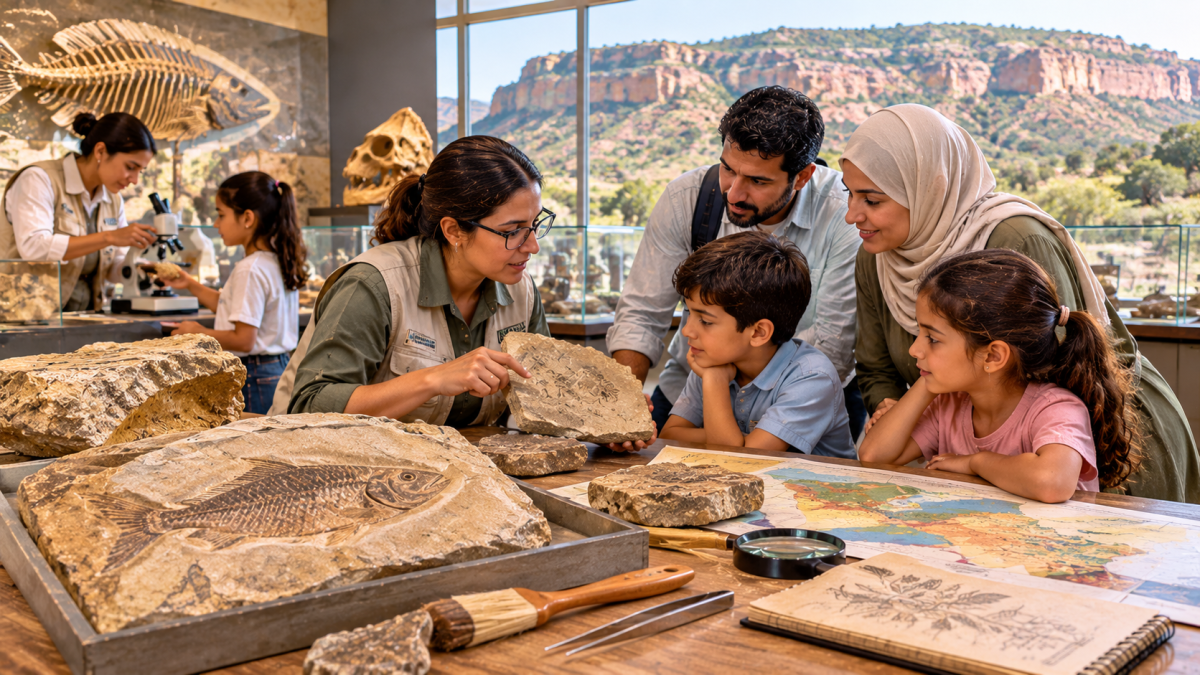
A different introduction to Brazil
A small fossil can change the way we understand a landscape. The outline of a fish or the impression of an insect invites us to look beyond today's surface and ask what once existed there. In northeastern Brazil, Araripe offers an engaging setting for that kind of curiosity. Its natural history provides a subject that families, students, and readers can explore through careful observation, even before considering a journey.
Araripe is a UNESCO Global Geopark within the Araripe sedimentary basin. Its landscape includes the sandstone plateau known as Chapada do Araripe, while its fossil deposits preserve evidence of ancient life. [1] For readers in the Arab world, the most useful introduction is to follow a few concrete questions. What does a fossil actually preserve? Why do different rocks contain different kinds of evidence? And how can a museum help us read what we see?
Why preservation matters
A fossil is physical evidence of past life, including preserved remains or traces. Fossilisation is uncommon: many organisms disappear without leaving such a record. Burial by sediment can slow decomposition, and minerals may help preserve structures over time. Different processes produce different fossil forms, so there is no single appearance that every fossil must have. [2]
This makes the quality of preservation important. When looking at a specimen, begin with what is visible rather than what you expect. Is the outline clear? Can you distinguish a repeated pattern or a particular structure? Does the label identify the material around it? These questions turn an attractive object into something that can be examined. They also encourage a useful habit: separating direct observation from the explanation supplied by a display.
The fine layers of Pedra Cariri
At Pedra Cariri near Nova Olinda, the Crato deposits include finely layered limestone associated with an ancient lake environment. The Brazilian Geological Survey describes an exceptionally preserved and varied fossil record, including insects, fish, and plants. [3] This variety gives the visitor more than one kind of object to consider.
An insect impression may invite attention to a small feature that would be missed in a quick photograph. A plant specimen encourages a different question about shape and arrangement. Place these observations beside those made from a fish, and a museum visit becomes a comparison rather than a race to see the largest exhibit. The point is not to identify every specimen yourself. It is to notice enough detail to ask a better question.
For a family activity, let each participant choose one display and describe it without using its name. Another person can then try to locate it from the description. Keep the exercise focused on visible features and follow the museum's rules. This simple approach rewards close attention and allows different ages to participate without needing the same scientific vocabulary.
Romualdo and fossils with depth
The Romualdo deposits offer another perspective. The Geological Survey records carbonate concretions containing exceptionally preserved fossils, including fish with three-dimensional preservation. It identifies Parque dos Pterossauros, near Santana do Cariri, as a geosite associated with these deposits. [4] The contrast with a thin impression helps explain why the surrounding rock deserves attention alongside the fossil.
Try comparing a flat outline with an object that retains depth, whether in a display or in a clearly labelled educational image. Which features are easier to recognise in each? Which remain difficult to interpret? Avoid assuming that a complete-looking reconstruction contains only original material. Read the label and ask which parts are original, reproduced, or reconstructed. The answer may make the exhibit more informative than its appearance alone suggests.
Understanding the flying reptiles
The name Parque dos Pterossauros introduces a group often confused with dinosaurs. Pterosaurs were flying reptiles, not dinosaurs. Their wings were supported by a greatly elongated fourth finger, and they were the first vertebrates to develop powered flight. [5] This distinction is a helpful example of why familiar labels sometimes need closer examination.
A drawing of a pterosaur wing can become an accessible exercise in reading a scientific illustration. Follow the bones from the body toward the wing's outer edge, then look for the long supporting finger. Use the diagram's own labels rather than guessing from a dramatic illustration. If a reconstruction shows colours or details not explained by the display, treat those as questions to investigate. Learning includes knowing which parts of an image represent evidence and which communicate an interpretation.
Begin with the museum
The Museu de Paleontologia Plácido Cidade Nuvens is located in Santana do Cariri and administered by the Regional University of Cariri, known as URCA. Its collection and educational role connect the region's fossil heritage with scientific learning. [6] A museum is a sensible starting point for understanding the subject before trying to interpret an outdoor location.
Plan a visit around a manageable theme, such as preservation, fish, or the difference between an original specimen and a reconstruction. Allow time to read labels and discuss a few objects rather than attempting to remember every name. Ask the museum directly about current opening arrangements, available explanations, and accessibility needs before making travel commitments. Do not assume that a guided activity or a particular language is available simply because the destination is internationally recognised.
Useful preparation can be modest. Save the institution's official name, mark the intended locations on a map, and prepare a few questions in advance. For an outdoor component, confirm access and arrangements with the site itself. A museum visit and a geosite visit are different experiences, and one does not automatically provide permission or access to the other.
Leave the evidence in place
Approach a fossil landscape as a place to learn, not a source of objects to take home. Do not break rock, remove specimens, or disturb a display. If something on a permitted route appears significant, leave it where it is and tell the responsible staff. A photograph or a sketch, where allowed, offers a way to record curiosity without changing the place.
The same care applies to learning at home. Choose a clearly identified museum image and write two short descriptions: what you can actually see, and what the accompanying explanation says. Keep unanswered questions separate. This exercise is inexpensive, easy to repeat, and useful for readers who want to explore Brazil's natural history without travelling.
Araripe's appeal lies in the connection between a specific landscape and the patient work of understanding its evidence. A fish fossil, a fine impression, or the structure of a wing can each hold attention when given enough time. For the curious reader, the best result is not a long list of unfamiliar names. It is a clearer sense of how a question becomes an observation, and how an observation can lead to further learning about Latin America.
Sources
[1] UNESCO — Araripe Global Geopark
[2] Natural History Museum — Fossil formation
[3] Brazilian Geological Survey — Crato deposits at Pedra Cariri
[4] Brazilian Geological Survey — Romualdo deposits
[5] American Museum of Natural History — Pterosaurs
[6] URCA — The paleontology museum in Santana do Cariri