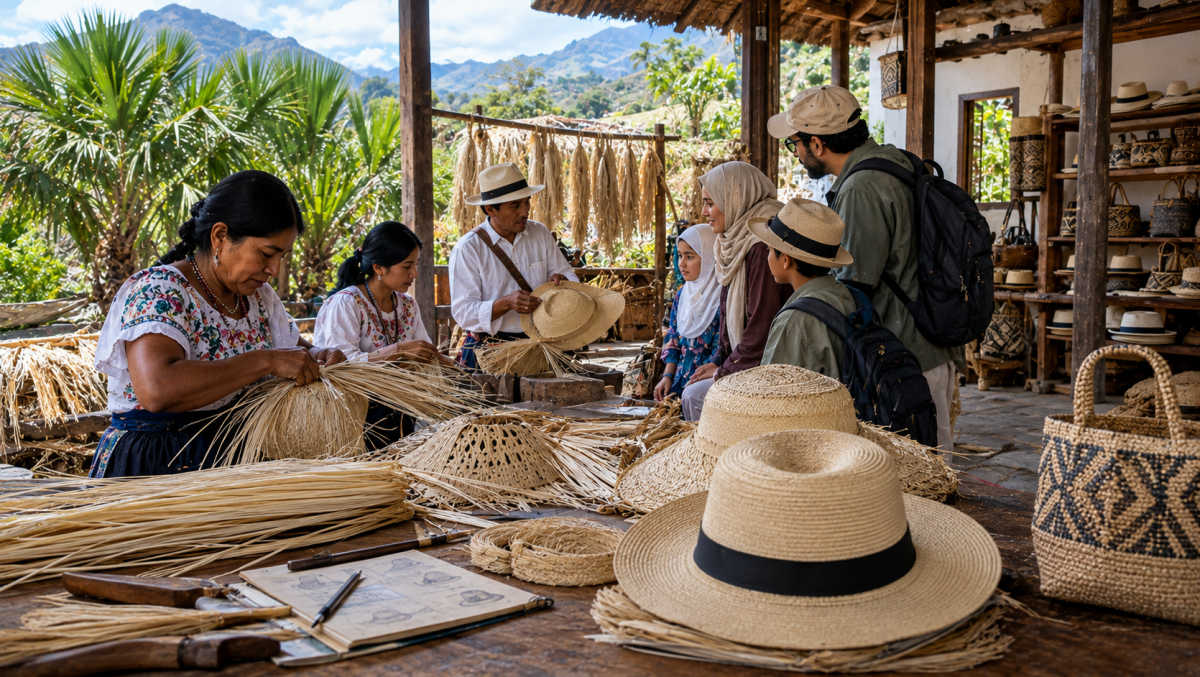
A finely woven toquilla hat invites a closer look. The surface can seem almost like cloth until the individual strands become visible. For NOLAM readers interested in Latin American craft, it offers a manageable starting point: one familiar object through which to explore material knowledge, skilled work, and the choices involved in buying a handmade product. This article follows those connections in Ecuador and suggests ways to approach the craft with curiosity and respect. Understanding the work behind the hat is more useful than judging it only by a label or a photograph.
Begin with the material
Toquilla comes from the plant Carludovica palmata. Kew places this species in the Cyclanthaceae family, rather than the family of true palms, and identifies its native range as extending from southern Mexico to Bolivia. It grows primarily in wet tropical environments. The familiar word “straw” therefore needs some care: it does not identify the stalk of a cereal crop in this case. [1]
That botanical detail changes the questions worth asking about a finished object. Where did its fibre come from? How was it prepared? Is the seller describing the material precisely? These questions connect a small purchase to the landscape that supplies it without requiring the buyer to become a botanist. They also prevent a common shortcut in craft appreciation, in which everything that looks pale and woven is treated as the same substance. Materials deserve names because their properties help explain what skilled hands can do with them.
Read the woven structure
Ecuador’s heritage institute describes weaving the crown and brim after the fibre has been prepared. It identifies Manabí, Azuay, and Cañar among the weaving provinces. In Pile, exceptionally fine work depends on particular climatic conditions and closely controlled rows. Finishing includes washing, pressing, and shaping. These are distinct operations, not a single uninterrupted gesture. [2]
When looking at a hat with permission, start at the crown and follow the woven surface towards the brim. Notice how a curved volume has emerged from narrow strands. Observe the edge, where the repeated pattern must reach a stable ending. Ask the maker which parts demand the most concentration and which irregularities matter. A visitor need not declare one piece superior to another to learn something useful. Looking carefully is already a better response than reducing the entire object to its retail price.
Recognize the work behind the finished hat
An account of toquilla production in Santa Elena describes a chain extending from collection and processing through drying, transport, craft production, sale, and repair. Different participants contribute at different stages. [3] The finished hat can consequently conceal much of the work that made it possible. The person demonstrating a final operation may be one contributor in a longer sequence, rather than the only maker of the object.
This is a helpful perspective for readers accustomed to shopping for handcrafted goods close to home. An attractive shop display tells only part of any product’s story. Ask where the weaving took place and where the final shaping was completed. Allow the seller to explain the distinction. A useful description should make the chain clearer instead of turning every stage into a vague claim of authenticity. Recognizing several contributions does not diminish craftsmanship; it makes the description of craftsmanship more accurate.
Understand what living heritage means
UNESCO identifies traditional Ecuadorian toquilla weaving as intangible cultural heritage. Its account of the tradition emphasizes community identity and the importance of younger generations continuing the technique. [4] The word “intangible” directs attention towards knowledge and practice. The hat is visible, but a substantial part of its cultural value lies in the ability to make another one and to pass that ability on.
Consider the difference between preserving an example and sustaining a skill. A carefully stored hat can show a pattern, yet it cannot correct a learner’s hand position or explain a difficult decision. Teaching needs time for observation, trial, and feedback. For visitors, this suggests a simple courtesy: do not expect a demonstration to proceed at the speed of a short video. Give a maker room to finish a movement before asking the next question. The pauses may reveal as much as the visible action.
Plan a visit around learning
Cuenca offers a concrete place to begin researching a craft visit. Homero Ortega lists a museum and main showroom there on its own contact page. [5] Ecuador’s tourism catalogue also includes its visitor experience. [6] This makes it a verifiable starting point, rather than a promise that every workshop welcomes visitors without notice. Contact the venue before travelling to confirm current access, available explanations, and any arrangements your group needs.
Decide what you want to learn before filling an itinerary. A focused visit could explore the difference between prepared fibre, an unfinished woven piece, and a shaped hat. Ask whether those stages can be seen during the visit. Confirm the language of any explanation, since a sign in one language does not establish that a guided visit is available in another. If step-free access or seating matters, ask specific questions rather than relying on the general word “accessible.” This preparation leaves more attention for the craft itself.
Buy through questions rather than slogans
If you choose to purchase a hat, begin with fit and intended use. A piece admired in a display may be uncomfortable when worn, and a purchase made for occasional use may call for different priorities from an everyday item. Ask the seller to explain the material, place of weaving, finishing work, and care instructions for that particular piece. Request written product information when these details are important to your decision.
Treat grand descriptions as invitations to ask for evidence. A prestigious place name alone does not explain how an individual hat was made. Nor does a high price automatically answer questions about workmanship or the maker’s return. Compare the clarity of the information as well as the object. Avoid bargaining that treats a lengthy demonstration as worthless. Equally, appreciation does not oblige you to buy beyond your budget. A courteous conversation can end with thanks and a better understanding.
Take the knowledge home
Ask for handling and storage guidance before packing, especially if the seller describes the hat as foldable or suitable for rolling. Do not test those claims on a piece without instruction. Keep the maker or shop details with the care information so that a later repair question has a clear destination. If you share photographs, obtain permission and identify the workshop accurately rather than attaching an unsupported story to the image.
Toquilla weaving offers a practical way to encounter Ecuador through the work of making. For an Arab reader, its strongest connection is the pleasure of understanding a skilled object on its own terms, while recognizing familiar questions about quality and patient learning. Look closely, ask clear questions, and leave space for the maker’s explanation. Whether or not a hat comes home with you, that approach turns a
Sources
[1] Kew Science — Carludovica palmata
[2] Ecuadorian heritage institute — Traditional toquilla weaving
[3] Ecuadorian heritage institute — Toquilla production in Santa Elena
[4] UNESCO — Toquilla weaving as intangible cultural heritage
[5] Homero Ortega — Museum and showroom contact information
[6] Ecuador Travel — Toquilla craft visitor catalogue