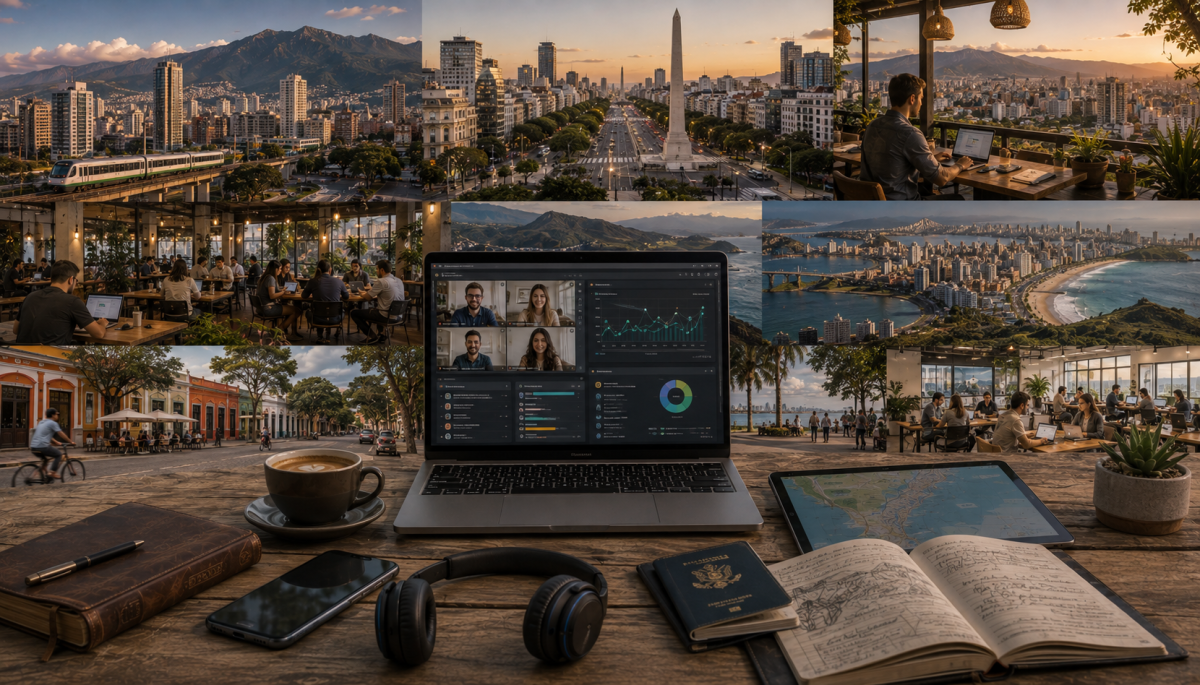
Digital Nomad Paradises: The Top Remote Work Destinations in Latin America
There was a time when "working abroad" meant a two-week business trip, a stiff suit, and a hotel conference room with bad coffee. That idea feels almost quaint now. Somewhere between the rise of fast home internet and the slow death of the nine-to-five office, a new kind of professional appeared — one who could open a laptop in Mexico City in the morning and close it in a rooftop co-working space in Medellín a few months later, without ever missing a client call.
Latin America, more than almost any other region on earth, has leaned into this shift. Not by accident, either. Governments noticed the trend early and started building the plumbing for it: digital nomad visas, startup-friendly tax zones, and a wave of co-working spaces that look more like boutique hotels than office parks.
Mexico City: The Cosmopolitan Infrastructure Hub
Mexico City is usually the first stop on this journey, and for good reason. It has the infrastructure of a global capital — fast fiber internet, an international airport with direct connections across the Americas and Europe, and a cost of living that still feels reasonable compared to New York or Dubai.
Neighborhoods like Roma Norte and Condesa have become unofficial nomad districts, filled with quiet cafés that double as informal offices by nine in the morning.
Medellín: Innovation, Climate, and Nomad Community
Then there's Medellín, Colombia — a city that spent decades being known for the wrong reasons and has spent the last one rewriting its own story. The "City of Eternal Spring" nickname isn't just poetic; the climate genuinely hovers in a comfortable range year-round, which matters more than people expect when you're staring at a screen for eight hours a day.
El Poblado, the city's most nomad-friendly district, has become a hub of shared workspaces, fast connectivity, and a growing community of long-term remote professionals from around the world.
Costa Rica and Argentina: Nature, Culture, and Value
Costa Rica takes a different approach entirely. Its digital nomad visa program was one of the first formalized in the region, offering a clear legal pathway for remote workers to stay for extended periods without the usual bureaucratic headache. Add to that a national obsession with sustainability, dependable infrastructure even in smaller towns, and a slower, calmer pace of life, and it's easy to see why so many professionals choose it not just to visit, but to stay.
Argentina, meanwhile, offers something different: scale and sophistication. Buenos Aires is a city built for walking, with wide boulevards, historic architecture, and a café culture that rewards long stretches of focused, uninterrupted work. The exchange rate has also made the city notably affordable for anyone earning in stronger foreign currencies, stretching a modest remote-work salary considerably further than it would go back home.
The Strategic and Financial Advantage for Remote Workers
What ties all of these places together isn't just Wi-Fi speed or visa paperwork — it's a broader shift in how the region sees itself. Latin American cities are no longer positioning themselves purely as tourist destinations to pass through. They're building the kind of long-term infrastructure — reliable power, robust broadband, functioning healthcare access, safe residential districts — that convinces a professional to unpack their bags rather than live out of a suitcase.
For Arab professionals specifically, the appeal runs a little deeper than convenience. Many of these cities offer a genuine change of scenery and culture without the friction of extreme time-zone gaps that plague fully remote work with Gulf or Levant-based clients — Colombia, for instance, sits close enough to US Eastern time that overlapping work hours are still very manageable. There's also a practical financial logic: salaries earned in stronger currencies go noticeably further in cities like Medellín or Mexico City than they would in Western Europe or North America, without sacrificing the quality of infrastructure a remote career depends on.
Of course, choosing a digital nomad hub isn't only about spreadsheets and visa stamps. It's about finding a place where daily life feels good — where the local market has fresh produce, where public transport actually works, where there's a rhythm to the day that doesn't feel foreign after the first week. Latin America, across its many different cities and cultures, has quietly built exactly that kind of environment for the modern remote professional.
Whether the goal is a six-month sabbatical or a full relocation, the region now offers something rare: genuine choice. Fast-paced and cosmopolitan in Buenos Aires, warm and community-driven in Medellín, efficient and centrally located in Mexico City, or calm and nature-focused in Costa Rica — there's a fit for nearly every kind of remote career.